
I include here a letter I recently sent to the Pennsylvania Gaming Control Board concerning the proposed casino at Gettysburg.
To Whom it May Concern,
I wish to express my displeasure with the continued manner in which the Pennsylvania Gaming Control Board (PGCB) informs the public of both the correspondence and testimony offered concerning the proposed casino at Gettysburg. On April 5 2006, at the PGCB Hearing at Gettysburg College, the vast majority of the people who testified expressed their vehement objection to allowing Chance Enterprises to build a casino near the Battlefield. Of the 33 private citizens to speak, 29 opposed the casino. After listening to the others present, I left the hearings encouraged. Knowing the government’s charge of representing the will of the people, I felt that Gettysburg might emerge free of a scourge that threatened to desecrate and damage the grounds upon which our ancestors fought and died.
However, as time passed, I realized that the PGCB had made public none of what we said that day. I contacted your offices seeking transcripts of the testimony. After some time awaiting a reply, and receiving notification that you would not publish this on-line, you informed me that I would need to go through a private company to obtain the transcripts. Unlike other minutes that the PGCB freely and publicly posts on-line, I would need to pay for a copy of our public record. Much to my continued exasperation, the company to which you directed me declined to quote a price. In fact, they ceased to respond at all.
I felt some measure of resurgent optimism when I noticed that the PGCB had posted a series of casino related public comments on their site. However, instead of posting searchable, easily readable text, the PGCB instead chose to post massive files of collections of scanned copies of some of the original documents. In doing so, the PGCB has contributed to the impression of bias concerning this issue. The first four web pages of posted comments concerning the Gettysburg casino contain almost exclusively if not entirely letters in support of that casino. The final eight pages hold the letters and petitions containing hundreds of vehement objections.
Along with rendering the task of reading the comments arduous at best, the PGCB has padded the first files which people are likely to read with those comments in favor of the casino. Nothing on that web page notes or explains this. The reader scanning the first few pages of comments may naturally assume that the citizenry expressed an overwhelming degree of support for a casino at Gettysburg. The PGCB must be keenly aware that this is most certainly not the case.
If I counted correctly, as of four days ago, the PGCB site hosted 687 pages against the casino and 243 pages in favor. The pages expressing support for the proposal included letters from persons working for or linked to Chance Enterprises, the Company wishing to build the casino.
Of note, I did not see any of the correspondence that I sent to the PGCB nor did I see the transcript of my testimony that I submitted to your stenographer the day of the hearing.
I would hope that, when you submit your final decision, you will support the will of the people and not permit a casino anywhere near the sacred ground of Gettysburg.
Sincerely,
Randy
Please visit my primary site at www.brotherswar.com
All original material Copyright © 2006. All Rights Reserved
Sunday, October 22, 2006


Friday, October 13, 2006
Hoping Old Jackson Would Not Catch Him
Richard Taylor, son of President Zachary Taylor, fought for the South throughout the American Civil War. Serving with General Thomas J. Jackson in the Shenandoah Valley Campaign, he aptly noted in his memoirs, "An actor therein, accident of fortune afforded me exceptional advantages for an interior view." A wonderful writer, he offered an insightful, somewhat humorous description of Confederate General Richard Stoddert Ewell who in turn discussed his views on the brilliant but eccentric "Stonewall" Jackson. The excerpt below appears in Taylor’s memoirs "Destruction And Reconstruction: Personal Experiences Of The Late War"
"For the first time Ewell had his division together and under his immediate command; and as we remained for many days between the rivers, I had abundant opportunities for studying the original character of "Dick Ewell. " We had known each other for many years, but now our friendship and intercourse became close and constant. Graduated from West Point in 1840, Ewell joined the 1st regiment of United States dragoons, and, saving the Mexican war, in which he served with such distinction as a young cavalryman could gain, his whole military life had been passed on the plains, where, as he often asserted, he had learned all about commanding fifty United States dragoons, and forgotten everything else. In this he did himself injustice, as his career proves; but he was of a singular modesty. Bright, prominent eyes, a bomb-shaped, bald head, and a nose like that of Francis of Valois, gave him a striking resemblance to a woodcock; and this was increased by a bird-like habit of putting his head on one side to utter his quaint speeches. He fancied that he had some mysterious internal malady, and would eat nothing but frumenty, a preparation of wheat; and his plaintive way of talking of his disease, as if he were some one else, was droll in the extreme. His nervousness prevented him from taking regular sleep, and he passed nights curled around a camp-stool, in positions to dislocate an ordinary person's joints and drive the "caoutchouc man" to despair. On such occasions, after long silence, he would suddenly direct his eyes and nose toward me with "General Taylor! What do you suppose President Davis made me a major-general for?" - beginning with a sharp accent and ending with a gentle lisp. Superbly mounted, he was the boldest of horsemen, invariably leaving the roads to take timber and water. No follower of the "Pytchley" or "Quorn" could have lived with him across country. With a fine tactical eye on the battle field, he was never content with his own plan until he had secured the approval of another's judgment, and chafed under the restraint of command, preparing to fight with the skirmish line. On two occasions in the Valley, during the temporary absence of Jackson from the front, Ewell summoned me to his side, and immediately rushed forward among the skirmishers, where some sharp work was going on. Having refreshed himself, he returned with the hope that "old Jackson would not catch him at it. " He always spoke of Jackson, several years his junior, as "old, " and told me in confidence that he admired his genius, but was certain of his lunacy, and that he never saw one of Jackson's couriers approach without expecting an order to assault the north pole.
Later, after he had heard Jackson seriously declare that he never ate pepper because it produced a weakness in his left leg, he was confirmed in this opinion. With all his oddities, perhaps in some measure because of them, Ewell was adored by officers and men."
Sincerely,
Randy
Please visit my primary site at www.brotherswar.com
All original material Copyright © 2006. All Rights Reserved
You can see the above document in its entirety at "Documenting the South"
They state on their site the following copyright information. "Academic Affairs Library, UNC-CH, University of North Carolina at Chapel Hill, 1998. © This work is the property of the University of North Carolina at Chapel Hill. It may be used freely by individuals for research, teaching and personal use as long as this statement of availability is included in the text."
"For the first time Ewell had his division together and under his immediate command; and as we remained for many days between the rivers, I had abundant opportunities for studying the original character of "Dick Ewell. " We had known each other for many years, but now our friendship and intercourse became close and constant. Graduated from West Point in 1840, Ewell joined the 1st regiment of United States dragoons, and, saving the Mexican war, in which he served with such distinction as a young cavalryman could gain, his whole military life had been passed on the plains, where, as he often asserted, he had learned all about commanding fifty United States dragoons, and forgotten everything else. In this he did himself injustice, as his career proves; but he was of a singular modesty. Bright, prominent eyes, a bomb-shaped, bald head, and a nose like that of Francis of Valois, gave him a striking resemblance to a woodcock; and this was increased by a bird-like habit of putting his head on one side to utter his quaint speeches. He fancied that he had some mysterious internal malady, and would eat nothing but frumenty, a preparation of wheat; and his plaintive way of talking of his disease, as if he were some one else, was droll in the extreme. His nervousness prevented him from taking regular sleep, and he passed nights curled around a camp-stool, in positions to dislocate an ordinary person's joints and drive the "caoutchouc man" to despair. On such occasions, after long silence, he would suddenly direct his eyes and nose toward me with "General Taylor! What do you suppose President Davis made me a major-general for?" - beginning with a sharp accent and ending with a gentle lisp. Superbly mounted, he was the boldest of horsemen, invariably leaving the roads to take timber and water. No follower of the "Pytchley" or "Quorn" could have lived with him across country. With a fine tactical eye on the battle field, he was never content with his own plan until he had secured the approval of another's judgment, and chafed under the restraint of command, preparing to fight with the skirmish line. On two occasions in the Valley, during the temporary absence of Jackson from the front, Ewell summoned me to his side, and immediately rushed forward among the skirmishers, where some sharp work was going on. Having refreshed himself, he returned with the hope that "old Jackson would not catch him at it. " He always spoke of Jackson, several years his junior, as "old, " and told me in confidence that he admired his genius, but was certain of his lunacy, and that he never saw one of Jackson's couriers approach without expecting an order to assault the north pole.
Later, after he had heard Jackson seriously declare that he never ate pepper because it produced a weakness in his left leg, he was confirmed in this opinion. With all his oddities, perhaps in some measure because of them, Ewell was adored by officers and men."
Sincerely,
Randy
Please visit my primary site at www.brotherswar.com
All original material Copyright © 2006. All Rights Reserved
You can see the above document in its entirety at "Documenting the South"
They state on their site the following copyright information. "Academic Affairs Library, UNC-CH, University of North Carolina at Chapel Hill, 1998. © This work is the property of the University of North Carolina at Chapel Hill. It may be used freely by individuals for research, teaching and personal use as long as this statement of availability is included in the text."
A Most Devoted Friend
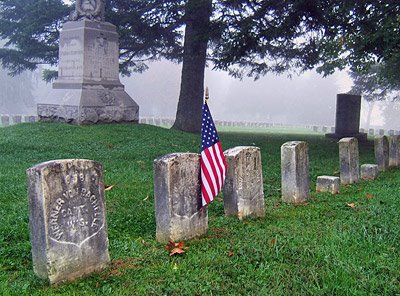
Some time ago, I stumbled upon a web site selling reproductions of two Civil War monuments. Along with one that proved very familiar, I found another involving Antietam that I had never before seen. The accompanying text offered the story of a Newfoundland dog that had wandered into the camp of the 6th Wisconsin. Captain Werner Von Bachelle of the 6th adopted him and soon they became inseparable.
Puzzled at not having seen this unusual monument, I wrote to the National Park Service at Antietam Battlefield asking about its location. Of course, much to my disappointment, they responded that it did not actually exist. However, I eagerly read more of the story that the ranger kindly included in his e-mail.
He wrote that Captain Von Bachelle lead his men into the cornfield during the Battle of Antietam only to be slain as they advanced. During their withdrawal, his men tried to no avail to coax the dog who had accompanied his friend into returning with them to safety. Two days later, Union soldiers found the faithful canine lying on top of his companion, both dead on the field. Rufus Dawes, then a Major in the 6th Wisconsin, reportedly lamented, "...it is probable he is joined in death by his most devoted friend on earth." The ranger added that, although unverified, the story asserts that the dog now rests along with Captain Von Bachelle in the Antietam National Cemetery.
The above picture shows Von Bachelle's gravestone marking the spot where the Captain now rests peacefully with at least 4,775 of his comrades. He is perhaps with one other who now happily walks beside him throughout all eternity.
You can see the monument mentioned above at 11th P.V.I. Preservation Foundation
Sincerely,
Randy
Please visit my primary site at www.brotherswar.com
All original material Copyright © 2006. All Rights Reserved
Thursday, October 12, 2006
A Minor Monumental Mystery
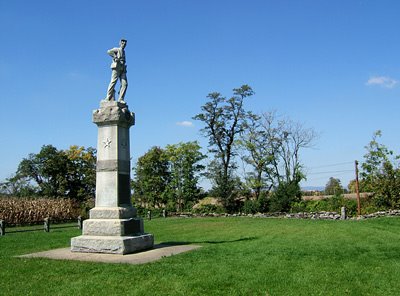
While visiting the Battlefield at Monocacy, I noticed an oddity concerning the 14th New Jersey Monument. Gracing three of its sides I noticed a star, a cross, and a diamond, the insignia for the 12th, 6th, and 3rd Corps respectively. Wondering about this, I wrote to the National Park Service. I received a quick, courteous, and simple answer from the NPS staff at Monocacy National Battlefield.
They said, "The Monocacy Regiment was assigned to various units throughout the war including the 8th Corps, 3rd Corps, 6th Corps, and 12th Corps." They added that the veterans decided to honor the various Corps with which they had been assigned.
Not only the site of its namesakes battle, the battlefield also plays host to the Best Farm. On those grounds, General Robert E. Lee wrote Special Orders 191, a copy of which eventually fell into the hands of Union General George B. McClellan. This one unlikely occurrence drastically altered the immediate course of events leading to the Battle of Antietam.
Respectfully,
Randy
Please visit my primary site at www.brotherswar.com
All original material Copyright © 2006. All Rights Reserved
Tuesday, October 10, 2006
Lee's Surrender & chat with General Meade
While again looking through the Project Gutenberg website, I found the following about General Robert E. Lee's surrender at Appomattox, written by one of his sons. Some rang familiar. Some I think we should never fail to re-read. The last segment revealed a surprisingly lighthearted interaction.
Recollections and Letters of General Lee
by Captain Robert E. Lee, His Son
"It is impossible to describe the anguish of the troops when it was known that the surrender of the army was inevitable. Of all their trials, this was the greatest and hardest to endure. There was no consciousness of shame; each heart could boast with honest pride that its duty had been done to the end, and that still unsullied remained its honour. When, after this interview with General Grant, General Lee again appeared, a shout of welcome instinctively went up from the army. But instantly recollecting the sad occasion that brought him before them, their shouts sank into silence, every hat was raised, and the bronzed faces of thousands of grim warriors were bathed in tears. As he rode slowly along the lines, hundreds of his devoted veterans pressed around the noble chief, trying to take his hand, touch his person, or even lay their hands upon his horse, thus exhibiting for him their great affection. The General then with head bare, and tears flowing freely down his manly cheeks, bade adieu to the army."
In a few words: "Men, we have fought through the war together; I have done my best for you; my heart is too full to say more," he bade them good-bye and told them to return to their homes and become good citizens. The next day he issued his farewell address, the last order published to the army:
"Headquarters, Army of Northern Virginia, April 10, 1865.
"After four years' of arduous service, marked by unsurpassed courage and fortitude, the Army of Northern Virginia has been compelled to yield to overwhelming numbers and resources. I need not tell the survivors of so many hard-fought battles, who have remained steadfast to the last, that I have consented to this result from no distrust of them; but, feeling that valour and devotion could accomplish nothing that could compensate for the loss that would have attended the continuation of the contest, I have determined to avoid the useless sacrifice of those whose past services have endeared them to their countrymen. By the terms of the agreement, officers and men can return to their homes and remain there until exchanged. You will take with you the satisfaction that proceeds from the consciousness of duty faithfully performed; and I earnestly pray that a merciful God will extend to you his blessing and protection. With an increasing admiration of your constancy and devotion to your country, and a grateful remembrance of your kind and generous consideration of myself, I bid you an affectionate farewell.
R. E. Lee, General."
General Long says that General Meade called on General Lee on the 10th, and in the course of conversation remarked:
"Now that the war may be considered over, I hope you will not deem it improper for me to ask, for my personal information, the strength of your army during the operations around Richmond and Petersburg."General Lee replied: "At no time did my force exceed 35,000 men; often it was less."
With a look of surprise, Meade answered: "General, you amaze me; we always estimated your force at about seventy thousand men."
General de Chanal, a French officer, who was present, states that General Lee, who had been an associate of Meade's in the engineers in the "old army," said to him pleasantly: "Meade, years are telling on you; your hair is getting quite gray."
"Ah, General Lee," was Meade's prompt reply, "it is not the work of
years; YOU are responsible for my gray hairs!"
This entire book can be found on-line at the Project Gutenberg web site. As with all of their on-line texts, Project Gutenberg states, "This eBook is for the use of anyone anywhere at no cost and with almost no restrictions whatsoever. You may copy it, give it away or re-use it under the terms of the Project Gutenberg License included with this eBook or online at www.gutenberg.net."
Sincerely,
Randy
Please visit my primary site at www.brotherswar.com
All original material Copyright © 2006. All Rights Reserved
Recollections and Letters of General Lee
by Captain Robert E. Lee, His Son
"It is impossible to describe the anguish of the troops when it was known that the surrender of the army was inevitable. Of all their trials, this was the greatest and hardest to endure. There was no consciousness of shame; each heart could boast with honest pride that its duty had been done to the end, and that still unsullied remained its honour. When, after this interview with General Grant, General Lee again appeared, a shout of welcome instinctively went up from the army. But instantly recollecting the sad occasion that brought him before them, their shouts sank into silence, every hat was raised, and the bronzed faces of thousands of grim warriors were bathed in tears. As he rode slowly along the lines, hundreds of his devoted veterans pressed around the noble chief, trying to take his hand, touch his person, or even lay their hands upon his horse, thus exhibiting for him their great affection. The General then with head bare, and tears flowing freely down his manly cheeks, bade adieu to the army."
In a few words: "Men, we have fought through the war together; I have done my best for you; my heart is too full to say more," he bade them good-bye and told them to return to their homes and become good citizens. The next day he issued his farewell address, the last order published to the army:
"Headquarters, Army of Northern Virginia, April 10, 1865.
"After four years' of arduous service, marked by unsurpassed courage and fortitude, the Army of Northern Virginia has been compelled to yield to overwhelming numbers and resources. I need not tell the survivors of so many hard-fought battles, who have remained steadfast to the last, that I have consented to this result from no distrust of them; but, feeling that valour and devotion could accomplish nothing that could compensate for the loss that would have attended the continuation of the contest, I have determined to avoid the useless sacrifice of those whose past services have endeared them to their countrymen. By the terms of the agreement, officers and men can return to their homes and remain there until exchanged. You will take with you the satisfaction that proceeds from the consciousness of duty faithfully performed; and I earnestly pray that a merciful God will extend to you his blessing and protection. With an increasing admiration of your constancy and devotion to your country, and a grateful remembrance of your kind and generous consideration of myself, I bid you an affectionate farewell.
R. E. Lee, General."
General Long says that General Meade called on General Lee on the 10th, and in the course of conversation remarked:
"Now that the war may be considered over, I hope you will not deem it improper for me to ask, for my personal information, the strength of your army during the operations around Richmond and Petersburg."General Lee replied: "At no time did my force exceed 35,000 men; often it was less."
With a look of surprise, Meade answered: "General, you amaze me; we always estimated your force at about seventy thousand men."
General de Chanal, a French officer, who was present, states that General Lee, who had been an associate of Meade's in the engineers in the "old army," said to him pleasantly: "Meade, years are telling on you; your hair is getting quite gray."
"Ah, General Lee," was Meade's prompt reply, "it is not the work of
years; YOU are responsible for my gray hairs!"
This entire book can be found on-line at the Project Gutenberg web site. As with all of their on-line texts, Project Gutenberg states, "This eBook is for the use of anyone anywhere at no cost and with almost no restrictions whatsoever. You may copy it, give it away or re-use it under the terms of the Project Gutenberg License included with this eBook or online at www.gutenberg.net."
Sincerely,
Randy
Please visit my primary site at www.brotherswar.com
All original material Copyright © 2006. All Rights Reserved
Friday, October 06, 2006
Off Topic:
A Little Girl's Courage & Self Sacrifice
Several days ago, with sorrowful disbelief and a stifling sadness, people across our country watched in horror as reporters relayed the tragic events that occurred in a small Amish community in Pennsylvania. Tonight, I read a related news article that left me utterly speechless. A few days ago, I wrote an article while in effect pondering the essence human nature and our capacities for good and evil. Reading this, I no longer wonder but sit here in stunned amazement. We have all seen evil. But would we ever have expected to see such bravery, valor, and courage, such goodness, in one small little girl.
I have copied the article below in its entirety. I will warn parents and younger readers that the content may prove disturbing. Younger children should read this only with their parent's consent.
New Massacre Revelation Shows Amish Girl Asked To Be Shot First
Friday October 6, 2006
The Amish live in a world where self sacrifice is a way of life and doing the right thing is the only choice.
And now a new revelation that follows that gruesome schoolhouse shooting on Monday appears to show they follow those rules even in death.
According to those who survived the rampage by Charles Roberts near Nickel Mines, Pennsylvania, one of the victims who was fatally wounded asked to be shot first so she could save the others.
Roberts burst into the one room schoolhouse, ordered all the males out, took 11 young girls hostage and then lined them up to shoot them, execution style. His last bullet was saved for himself.
When it became clear the gunman intended to carry out his deadly mission, 13-year-old Marian Fisher stepped forward, pleading with him to shoot her first, hoping he might spare the others.
There's no word if Roberts complied with the request.
Her 11-year-old sister Barbie then followed her lead, asking to be shot next. She survived the ambush. Marian did not. Barbie was at her sister's funeral on Thursday, before returning to hospital for treatment of her injuries.
The revelations came from the younger sister, who confided the horror to the nurse-midwife that delivered her sister more than a decade ago. "She said Marian said, 'Shoot me first,'" Rita Rhoads reveals. "Apparently what she was trying to do was to save the younger girls.
"It was very courageous of the girls to offer themselves. God was really present to give the girls that kind of courage."
Fisher and four others were buried on Thursday. A fifth child was taken off life support and died late this week. She was laid to rest on Friday.
Roberts left a number of suicide notes behind, claiming he had molested some family members 20 years ago and 'dreamed' he would do it again. He also revealed a hatred for God and the world when his premature baby died just 20 minutes after being born.
Sincerely,
Randy
Source: City News CP 24 Toronto, Ontario
Please visit my primary site at www.brotherswar.com
All original material Copyright © 2006. All Rights Reserved
I have copied the article below in its entirety. I will warn parents and younger readers that the content may prove disturbing. Younger children should read this only with their parent's consent.
New Massacre Revelation Shows Amish Girl Asked To Be Shot First
Friday October 6, 2006
The Amish live in a world where self sacrifice is a way of life and doing the right thing is the only choice.
And now a new revelation that follows that gruesome schoolhouse shooting on Monday appears to show they follow those rules even in death.
According to those who survived the rampage by Charles Roberts near Nickel Mines, Pennsylvania, one of the victims who was fatally wounded asked to be shot first so she could save the others.
Roberts burst into the one room schoolhouse, ordered all the males out, took 11 young girls hostage and then lined them up to shoot them, execution style. His last bullet was saved for himself.
When it became clear the gunman intended to carry out his deadly mission, 13-year-old Marian Fisher stepped forward, pleading with him to shoot her first, hoping he might spare the others.
There's no word if Roberts complied with the request.
Her 11-year-old sister Barbie then followed her lead, asking to be shot next. She survived the ambush. Marian did not. Barbie was at her sister's funeral on Thursday, before returning to hospital for treatment of her injuries.
The revelations came from the younger sister, who confided the horror to the nurse-midwife that delivered her sister more than a decade ago. "She said Marian said, 'Shoot me first,'" Rita Rhoads reveals. "Apparently what she was trying to do was to save the younger girls.
"It was very courageous of the girls to offer themselves. God was really present to give the girls that kind of courage."
Fisher and four others were buried on Thursday. A fifth child was taken off life support and died late this week. She was laid to rest on Friday.
Roberts left a number of suicide notes behind, claiming he had molested some family members 20 years ago and 'dreamed' he would do it again. He also revealed a hatred for God and the world when his premature baby died just 20 minutes after being born.
Sincerely,
Randy
Source: City News CP 24 Toronto, Ontario
Please visit my primary site at www.brotherswar.com
All original material Copyright © 2006. All Rights Reserved
Subscribe to:
Posts (Atom)
