
In the mid 1880s, The Century magazine published a series of articles written about the various battles of the war by the men who led their armies into those conflicts. Confederate Lieutenant General Daniel Harvey Hill wrote a section concerning the Battle of South Mountain, just prior to the Battle of Antietam. Before discussing the fighting, he took a moment to relay his thoughts on why others might instead refer to these two battles as those of Boonsboro and Sharpsburg. He also did not miss the opportunity to take a shot at those who fanned the flames of war but kept their distance from the fire.
"THE conflict of the 14th of September, 1862, is called at the North the battle of South Mountain, and at the South the battle of Boonsboro. So many battle-fields of the Civil War bear double names that we cannot believe the duplication has been accidental. It is the unusual which impresses. The troops of the North came mainly from cities, towns, and villages, and were, therefore, impressed by some natural object near the scene of the conflict and named the battle from it. The soldiers from the South were chiefly from the country and were, therefore, impressed by some artificial object near the field of action. In one section the naming has been after the handiwork of God; in the other section it has been after the handiwork of man. Thus, the first passage of arms is called the battle of Bull Run at the North,---the name of a little stream. At the South it takes the name of Manassas, from a railroad station. The second battle on the same ground is called the Second Bull Run by the North, and the Second Manassas by the South. Stone's defeat is the battle of Ball's Bluff with the Federals, and the battle of Leesburg with the Confederates. The battle called by General Grant, Pittsburg Landing, a natural object, was named Shiloh, after a church, by his antagonist. Rosecrans called his first great fight with Bragg, the battle of Stone River, while Bragg named it after Murfreesboro', a village. So McClellan's battle of the Chickahominy, a little river, was with Lee the battle of Cold Harbor, a tavern. The Federals speak of the battle of Pea Ridge, of the Ozark range of mountains, and the Confederates call it after Elk Horn, a country inn. The Union soldiers called the bloody battle three days after South Mountain from the little stream, Antietam, and the Southern troops named it after the village of Sharpsburg. Many instances might be given of this double naming by the opposing forces. According to the same law of the unusual, the war-songs of a people have generally been written. The bards who followed the banners of the feudal lords, sang of their exploits, and stimulated them and their retainers to deeds of high emprise, wore no armor and carried no swords. So, too, the impassioned orators, who roused our ancestors in 1776 with the thrilling cry, "Liberty or Death," never once put themselves in the way of a death by lead or steel, by musket-ball or bayonet stab. The noisy speakers of 1861, who fired the Northern heart and who fired the Southern heart, never did any other kind of firing."
Sincerely,
Randy
Please visit my primary site at www.brotherswar.com
All original material Copyright © 2006. All Rights Reserved
Source: eHistory.com: Ohio State University
Sunday, November 12, 2006


Saturday, November 04, 2006
Window Into McClellan
While reading Stephen W. Sears excellent book "Landscape Turned Red: The Battle of Antietam", I reacted with surprise to one small sentence. Characterizations of General George Brinton McClellan typically paint him as exclusively a soldiers general, a great organizer, timid on the battlefield, and frequently directing his wrath at any government or army official foolish enough to challenge his authority. His men adored him like no other Union commander. This is perhaps why I reacted with surprise when I read on page 279 the general's response to the 79th New York, a group of Scottish soldiers who had refused to fight unless the army lifted the ban on wearing kilts. The sentence read,
"McClellan's response was to surround them with hardbitten regulars with orders to shoot if the volunteers did not promptly return to duty..."
This side of General McClellan seems rarely discussed.
Sincerely,
Randy
Please visit my primary site at www.brotherswar.com
All original material Copyright © 2006. All Rights Reserved
"McClellan's response was to surround them with hardbitten regulars with orders to shoot if the volunteers did not promptly return to duty..."
This side of General McClellan seems rarely discussed.
Sincerely,
Randy
Please visit my primary site at www.brotherswar.com
All original material Copyright © 2006. All Rights Reserved
Our Army is Generally Badly Cut Up
After the Battle of Gettysburg, Captain J. J. Young of the 26th North Carolina wrote this grim assessment of the fighting to Governor Zebulon Vance.
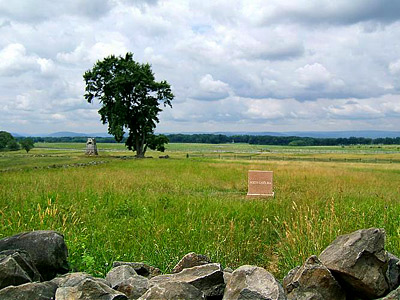 The 26th North Carolina Marker
noting the point of the regiment's advance
just feet from the Union line on Cemtery Ridge.
"Near Gettysburg, PA., July 4, 1863.
My Dear Governor:
I will trespass a few minutes upon your indulgence to communicate the sad fate that has befallen the old Twenty-sixth. The heaviest conflict of the war has taken place in this vicinity. It commenced July 1, and raged furiously until late last night. Heth's division, of A. P. Hill's corps, opened the ball, and Pettigrew's brigade was the advance. We went in with over 800 men in the regiment. There came out but 216, all told, unhurt. Yesterday they were again engaged, and now have only about 80 men for duty. To give you an idea of the frightful loss in officers: Heth being wounded, Pettigrew commands the division and Major J. Jones our brigade. Eleven men were shot down the first day with our colors; yesterday they were lost. Poor Colonel Burgwyn, jr., was shot through both lungs, and died shortly afterward. His loss is great, for he had but few equals of his age. Captain McCreery, of General Pettigrew's staff, was shot through the heart and instantly killed' with them Lieutenant-Colonel Lane through the neck, jaw, and mouth, I fear mortally; Adjutant James B. Jordan in the hip, severely; Captain J. T. Adams, shoulder, seriously; Stokes McRae's thigh broken; Captain William Wilson was killed; Lieutenants John W. Richardson and J. B. Holloway have died of their wounds. It is thought Lieutenant M. McLeod and Captain N. G. Bradford will die. Nearly all the rest of the officers were slightly wounded. I. A. Jarratt I had forgotten to mention-in the face and hand. Yesterday, Captain S. P. Wagg was shot through by grape and instantly killed; Lieutenant G. Broughton in the head, and instantly killed, Alexander Saunders was wounded and J. R. Emerson left on the field for dead. Captain H. C. Albright is the only captain left in the regiment unhurt, and commands the regiment. Lieutenants J. A. Lowe, M. B. Blair, T. J. Cureton, and C. M. Sudderth are all of the subalterns. Colonel Faribault, of the Forty-seventh, is severely wounded. Lieutenant-Colonel J. A. Graves and Major A. D. Crudup supposed killed. Colonel Marshall and Major J. Q. Richardson, of the Fifty-second, supposed to be killed. Lieutenant-Colonel Parks dangerously wounded; Colonel Leventhorpe badly wounded; Major Ross killed. Our whole division numbers but only 1,500 or 1,600 effective men, as officially reported, but, of course, a good many will still come in. The division at the beginning numbered about 8,000 effective men. I hear our army is generally badly cut up. We will fall back about 5 miles, to draw the enemy, if possible, from his impregnable position. It was a second Fredericksburg affair, only the wrong way. We had to charge over a mile a stone wall in an elevated position. I learn the loss of the enemy is terrible. We have taken 10,000 or 15,000 prisoners in all. Yesterday, in falling back, we had to leave the wounded; hence the uncertainty of a good many being killed late yesterday evening. I must close.
Yours truly,
J. J. Young, Captain, and Assistant Quartermaster.
His Excellency Gov. Zebulon B. Vance."
Sincerely,
Randy
Please visit my primary site at www.brotherswar.com
All original material Copyright © 2006. All Rights Reserved
Source: The War of the Rebellion: A Compilation of the Official Records of the Union and Confederate Armies
The text appears as it does in the record minus 21 sets of brackets "[ ]" which made the reading difficult. The brackets were around the initials of the names noted above.
 The 26th North Carolina Marker
noting the point of the regiment's advance
just feet from the Union line on Cemtery Ridge.
"Near Gettysburg, PA., July 4, 1863.
My Dear Governor:
I will trespass a few minutes upon your indulgence to communicate the sad fate that has befallen the old Twenty-sixth. The heaviest conflict of the war has taken place in this vicinity. It commenced July 1, and raged furiously until late last night. Heth's division, of A. P. Hill's corps, opened the ball, and Pettigrew's brigade was the advance. We went in with over 800 men in the regiment. There came out but 216, all told, unhurt. Yesterday they were again engaged, and now have only about 80 men for duty. To give you an idea of the frightful loss in officers: Heth being wounded, Pettigrew commands the division and Major J. Jones our brigade. Eleven men were shot down the first day with our colors; yesterday they were lost. Poor Colonel Burgwyn, jr., was shot through both lungs, and died shortly afterward. His loss is great, for he had but few equals of his age. Captain McCreery, of General Pettigrew's staff, was shot through the heart and instantly killed' with them Lieutenant-Colonel Lane through the neck, jaw, and mouth, I fear mortally; Adjutant James B. Jordan in the hip, severely; Captain J. T. Adams, shoulder, seriously; Stokes McRae's thigh broken; Captain William Wilson was killed; Lieutenants John W. Richardson and J. B. Holloway have died of their wounds. It is thought Lieutenant M. McLeod and Captain N. G. Bradford will die. Nearly all the rest of the officers were slightly wounded. I. A. Jarratt I had forgotten to mention-in the face and hand. Yesterday, Captain S. P. Wagg was shot through by grape and instantly killed; Lieutenant G. Broughton in the head, and instantly killed, Alexander Saunders was wounded and J. R. Emerson left on the field for dead. Captain H. C. Albright is the only captain left in the regiment unhurt, and commands the regiment. Lieutenants J. A. Lowe, M. B. Blair, T. J. Cureton, and C. M. Sudderth are all of the subalterns. Colonel Faribault, of the Forty-seventh, is severely wounded. Lieutenant-Colonel J. A. Graves and Major A. D. Crudup supposed killed. Colonel Marshall and Major J. Q. Richardson, of the Fifty-second, supposed to be killed. Lieutenant-Colonel Parks dangerously wounded; Colonel Leventhorpe badly wounded; Major Ross killed. Our whole division numbers but only 1,500 or 1,600 effective men, as officially reported, but, of course, a good many will still come in. The division at the beginning numbered about 8,000 effective men. I hear our army is generally badly cut up. We will fall back about 5 miles, to draw the enemy, if possible, from his impregnable position. It was a second Fredericksburg affair, only the wrong way. We had to charge over a mile a stone wall in an elevated position. I learn the loss of the enemy is terrible. We have taken 10,000 or 15,000 prisoners in all. Yesterday, in falling back, we had to leave the wounded; hence the uncertainty of a good many being killed late yesterday evening. I must close.
Yours truly,
J. J. Young, Captain, and Assistant Quartermaster.
His Excellency Gov. Zebulon B. Vance."
Sincerely,
Randy
Please visit my primary site at www.brotherswar.com
All original material Copyright © 2006. All Rights Reserved
Source: The War of the Rebellion: A Compilation of the Official Records of the Union and Confederate Armies
The text appears as it does in the record minus 21 sets of brackets "[ ]" which made the reading difficult. The brackets were around the initials of the names noted above.
Sunday, October 29, 2006
Short Story: All Hallows Eve
Dedicated to a friend to whom I promised to write this story.
Happy Halloween CP.
--------------------------------
An unusually biting October wind howled through the near leaf-bare Virginia trees. The northern gusts blew the branches to and fro while the ancient trees fought back against them. The thin upper branches dug their fingers in the deepening autumn sky as if to brace themselves against a coming maelstrom. The cold rushing air seemed to mockingly boast of its victory over the life that had thrived throughout the passing vibrant summer. The dried now fallen leaves scattered along the forest floor, rustling throughout at the whims of the victorious gusts of fall.
He stood at his post in awe of nature’s spectacle. The forceful roar reminded him of the crashing waves near his distant Massachusetts home. The noisy rushing air would make vigilance all the more necessary. Because of it, he would likely see Rebels approaching before he could hear them. Not wishing the enemy to see him, he sat among a dense grouping of scrub oak, propping his musket against the sturdiest of the bunch. The wind continued to toss around the tops of the trees as if God roughly waved his hands through tall fields of grass. He could barely hear the leaves crunching under his shifting weight as he sought a comfortable spot to rest.
Taking advantage of the last few moments of sunlight, he pulled out a small book and pencil. The diary, a gift from his sister, had the familiar outline of his first home stamped into the soft leather cover. He traced the borders of Ireland with his finger, thinking of his birth home, Kathleen, and the rest of his family. He hoped to see them all soon. Glancing disapprovingly at the dull pencil tip, he took out his knife and, with short quick strokes, sharpened the point. Upon re-sheathing his knife, he brushed the shavings off his pant legs, turned to a blank page, and began to write.
"October 31, 1863. We marched only 12 miles today. The days are quickly getting cooler and shorter. We did not see any Rebs today although Andrew says he heard they are near. We don’t expect a fight but are ready if one comes." Gazing around the dimming landscape, he could think of no more to write. This last day of October proved thus far to be typical and unremarkable.
Closing the book, he slipped the small pencil into the gap between the cover and the bound edge of the pages. He placed the diary back into his sack and glanced around his temporary realm. Darkness had begun to stake its hold on the woods. "October 31st" he thought. "All Hallows Eve." A sad smile came to his face as he thought of the celebrations now well underway in Ireland. He could smell the familiar food and picture the army of carved turnips decorating the neighborhood homes. The sculpted vegetables seemed somehow vigilant, knowing of their mission to drive away the lost souls said to prowl the earth this one night. His new country thought this a child’s holiday, nothing to which a grown man should devote any attention.
With a slight sense of defiance, he felt around in his haversack and, making a careful choice, pulled out a small but adequately round turnip he had saved for a meal. Unsheathing his knife, he carefully cut out the neck from where the leaves had grown and severed the thin taproot from underneath. Digging out and eating the inside of the hard fleshy bulb, he carefully left enough of an outer shell for his next task. Racing the fleeting day’s light, he finished the portions he would eat and began carving a small sufficiently sinister looking face. After some time and careful struggle with the solid bulbous root, he finished.
Setting the hollowed bulb on the cool damp ground, hidden behind the large tree against which he sat, he fished out of his sack the small remains of a candle. Trimming the wick to limit its brightness, he placed it with nostalgic reverence inside. Once lit, the lantern along with the carpet of leaves, twisted roots, and the chill air completed the picture. He sat against the back of his tree with his new companion and listened to the night.
After a time, with the air growing still, he heard the sound of leaves under foot. Quickly looking to his small sentinel, he snuffed out the tiny candle, feeling slightly foolish for providing a beacon to his location. He caught a slight whiff of the smoke that he could not see in the near complete darkness. Feeling for his musket, he straightened his back against the tree and listened. In a few moments, he heard it again, the sound of a step or two. He needed his visitor to make a few more sounds to be sure of his approximate location.
He reached for his musket and as quietly as he could, loaded one ball. Another crunch came from the darkness, this time in his front right. "So there could be two", he thought trying to take control of his rising anxiety. "Do the others hear them?" he wondered. Peaking around his tree, looking between two smaller trunks, he peered into the enveloping darkness hoping to glimpse his visitor. As the night’s drifting clouds unveiled the half autumn moon, he began to discern the faint outlines of the trees to his front. Still seated, placing his rifle aside, he waited.
With his back to the tree, the next sound seemed to come from in front of him. "What’s this about?" he questioned silently, feeling his heart beat faster. No one had passed him. Of that, he felt certain. The breeze that had earlier taken its rest, again awoke stirring the leaves on the ground and rustling those still clinging above. A frigid chill possessed the air. He shivered somewhat but paid little attention. His eyes strained to see through the chill darkness, casting about as he turned his head, desperately trying to make out some form or shape.
"There!" The word shouted in his mind. "I see him." He stared at a figure, not too far from him, standing between some trees only about 20 yards in his front. He wanted to call out, command him to halt, ask for the counter sign, but others may be close. To be safe, he would wait.
Several seconds passed, then a minute, then two. His visitor remained silent and unmoving. He thought of reaching for his musket but opted instead for silence. Surely, the bleak darkness hid him from sight. Finally, the figure moved. Starting slowly at first, he seemed to glide among the trees. His heart pounded harder. His eyes widened as he realized that now, he heard no footsteps. Not a sound came from the figure as it approached. As his eyes focused, he could see it moving towards his right. "The others will see him," he thought.
The figured passed by, about 15 feet away, without the slightest hint that he was there except for the outline of his form. He could make out none of the man’s features, neither his face nor his uniform. Strangest of all, he carried no musket. Looking back to where the figure had come, he saw another man, closer, and moving. Peering intently into the blackness, he noticed another faint form with him. They both moved, silently, closer than the other to where he sat against his tree. Telling himself he would demand they halt once they passed, he leaned back, breathing faster through his mouth, chest expanding, trying to stay quiet. Glancing to his left, he saw two more, closer still. His heart pounded so that he thought it would surely give him away. He feared the whole woodland could hear him. He tried to control his breathing. "What is this?" he demanded silently. Looking again he saw more, many more, coming towards their lines, silently all, and without muskets. He could not count them now, nor would he. Panic gripped him as he tried to make sense of figures gliding faster through the night making not a sound. He closed his eyes and, with his free hand, rubbed hard.
Upon opening his eyes, he recoiled back hard against the tree, rigid with fright. A man, no, something else, stood just a few feet in his front glaring at him. The menacing figure exuded a dark unmistakable hatred. Paralyzed, he sat motionless as it slowly yet deliberately reached out to him with both hands and, like a vise, gripped his head in a smothering grasp. He swung feebly at the figure, screamed aloud, but it did not move. Fear raced through him, consumed him, saturated every corner of his soul. He wanted to scream again but could not speak. He wanted to run but could not move. The powerful figure held him, seemed to blend with him, keeping him in place. Fear, anger, and hatred coursed through him as if thousands of tortured souls demanded the use of his body, his voice to wail their unremitting torment. Despite the pulsating vitriolic wrath, he sensed in the figure something else, something feeding the anger. He felt a deep undercurrent of crushing unrelenting sorrow.
Hosts of these figures now filled the dark woods, gliding faster, almost frantically, as if they feared not reaching their sinister destinations in time. None noticed him except his singular malicious tormentor. He gazed up at him and to his horror, saw the moon behind him, realizing he could see it through him. A volcanic rage possessed him, coursing from the figure through him. It gripped harder and leaned in, bringing its head to within inches. He could smell the foul wretched breath, the corrupt stench of death from so many battlefields and soldiers graves. The hideous, sulfurous smell threatened to consume him as its malevolence violated his very being. Yet he could feel them all, the countless souls in agonizing pain.
A voice, no thousands of voices screamed inside his head, unearthly shrieks that he seemed able to see, taste, and smell. The vile chorus howled in searing agony, the frenzied cacophony growing louder and louder still. Able to move his arms, he grabbed his head, tried to crush it between his palms, but the voices raged. He thrashed frantically in the air, yet the screaming grew. Able to speak he added his voice to the symphony of pain, flailing about in the darkness, begging it to stop. His hand hit against something at his side. Instinctively, desperately, he seized it and hurled it at the figure.
Like the sudden rush of air from a room, the woods instantly went silent. Not a sound reached his ears except the rustling of a few dry leaves. A faint autumn breeze softly caressed the slumbering landscape. Slight clouds drifted across a starry night’s sky. The figures had vanished.
On trembling legs, he stood, took up his musket, and peered into the darkness. As his eyes adjusted, he saw around him only the deep empty woods. An hour passed, then two. Not a sound echoed. Anxiety rose again. This time, he feared the punishment for sleeping at picket. He remained at his post alert and awake until the early November sun rose in the east, painting the tips of the trees with a warming orange light.
He said nothing to his friends, worried they would poke fun at his dream. With the boredom of winter camp looming, he did not wish to be the butt of a season’s worth of jokes.
As he walked through the woods with his comrades returning to camp, one of them stopped and looked towards his feet. Puzzled, the soldier lightly kicked what to him looked like a hollow skinned potato. As it turned over, he saw that it was a turnip, partially smashed as if thrown violently to the ground. He walked away swearing that, on one side, it had a face.
Sincerely,
Randy
Please visit my primary site at www.brotherswar.com
All original material Copyright © 2006. All Rights Reserved
Happy Halloween CP.
--------------------------------
An unusually biting October wind howled through the near leaf-bare Virginia trees. The northern gusts blew the branches to and fro while the ancient trees fought back against them. The thin upper branches dug their fingers in the deepening autumn sky as if to brace themselves against a coming maelstrom. The cold rushing air seemed to mockingly boast of its victory over the life that had thrived throughout the passing vibrant summer. The dried now fallen leaves scattered along the forest floor, rustling throughout at the whims of the victorious gusts of fall.
He stood at his post in awe of nature’s spectacle. The forceful roar reminded him of the crashing waves near his distant Massachusetts home. The noisy rushing air would make vigilance all the more necessary. Because of it, he would likely see Rebels approaching before he could hear them. Not wishing the enemy to see him, he sat among a dense grouping of scrub oak, propping his musket against the sturdiest of the bunch. The wind continued to toss around the tops of the trees as if God roughly waved his hands through tall fields of grass. He could barely hear the leaves crunching under his shifting weight as he sought a comfortable spot to rest.
Taking advantage of the last few moments of sunlight, he pulled out a small book and pencil. The diary, a gift from his sister, had the familiar outline of his first home stamped into the soft leather cover. He traced the borders of Ireland with his finger, thinking of his birth home, Kathleen, and the rest of his family. He hoped to see them all soon. Glancing disapprovingly at the dull pencil tip, he took out his knife and, with short quick strokes, sharpened the point. Upon re-sheathing his knife, he brushed the shavings off his pant legs, turned to a blank page, and began to write.
"October 31, 1863. We marched only 12 miles today. The days are quickly getting cooler and shorter. We did not see any Rebs today although Andrew says he heard they are near. We don’t expect a fight but are ready if one comes." Gazing around the dimming landscape, he could think of no more to write. This last day of October proved thus far to be typical and unremarkable.
Closing the book, he slipped the small pencil into the gap between the cover and the bound edge of the pages. He placed the diary back into his sack and glanced around his temporary realm. Darkness had begun to stake its hold on the woods. "October 31st" he thought. "All Hallows Eve." A sad smile came to his face as he thought of the celebrations now well underway in Ireland. He could smell the familiar food and picture the army of carved turnips decorating the neighborhood homes. The sculpted vegetables seemed somehow vigilant, knowing of their mission to drive away the lost souls said to prowl the earth this one night. His new country thought this a child’s holiday, nothing to which a grown man should devote any attention.
With a slight sense of defiance, he felt around in his haversack and, making a careful choice, pulled out a small but adequately round turnip he had saved for a meal. Unsheathing his knife, he carefully cut out the neck from where the leaves had grown and severed the thin taproot from underneath. Digging out and eating the inside of the hard fleshy bulb, he carefully left enough of an outer shell for his next task. Racing the fleeting day’s light, he finished the portions he would eat and began carving a small sufficiently sinister looking face. After some time and careful struggle with the solid bulbous root, he finished.
Setting the hollowed bulb on the cool damp ground, hidden behind the large tree against which he sat, he fished out of his sack the small remains of a candle. Trimming the wick to limit its brightness, he placed it with nostalgic reverence inside. Once lit, the lantern along with the carpet of leaves, twisted roots, and the chill air completed the picture. He sat against the back of his tree with his new companion and listened to the night.
After a time, with the air growing still, he heard the sound of leaves under foot. Quickly looking to his small sentinel, he snuffed out the tiny candle, feeling slightly foolish for providing a beacon to his location. He caught a slight whiff of the smoke that he could not see in the near complete darkness. Feeling for his musket, he straightened his back against the tree and listened. In a few moments, he heard it again, the sound of a step or two. He needed his visitor to make a few more sounds to be sure of his approximate location.
He reached for his musket and as quietly as he could, loaded one ball. Another crunch came from the darkness, this time in his front right. "So there could be two", he thought trying to take control of his rising anxiety. "Do the others hear them?" he wondered. Peaking around his tree, looking between two smaller trunks, he peered into the enveloping darkness hoping to glimpse his visitor. As the night’s drifting clouds unveiled the half autumn moon, he began to discern the faint outlines of the trees to his front. Still seated, placing his rifle aside, he waited.
With his back to the tree, the next sound seemed to come from in front of him. "What’s this about?" he questioned silently, feeling his heart beat faster. No one had passed him. Of that, he felt certain. The breeze that had earlier taken its rest, again awoke stirring the leaves on the ground and rustling those still clinging above. A frigid chill possessed the air. He shivered somewhat but paid little attention. His eyes strained to see through the chill darkness, casting about as he turned his head, desperately trying to make out some form or shape.
"There!" The word shouted in his mind. "I see him." He stared at a figure, not too far from him, standing between some trees only about 20 yards in his front. He wanted to call out, command him to halt, ask for the counter sign, but others may be close. To be safe, he would wait.
Several seconds passed, then a minute, then two. His visitor remained silent and unmoving. He thought of reaching for his musket but opted instead for silence. Surely, the bleak darkness hid him from sight. Finally, the figure moved. Starting slowly at first, he seemed to glide among the trees. His heart pounded harder. His eyes widened as he realized that now, he heard no footsteps. Not a sound came from the figure as it approached. As his eyes focused, he could see it moving towards his right. "The others will see him," he thought.
The figured passed by, about 15 feet away, without the slightest hint that he was there except for the outline of his form. He could make out none of the man’s features, neither his face nor his uniform. Strangest of all, he carried no musket. Looking back to where the figure had come, he saw another man, closer, and moving. Peering intently into the blackness, he noticed another faint form with him. They both moved, silently, closer than the other to where he sat against his tree. Telling himself he would demand they halt once they passed, he leaned back, breathing faster through his mouth, chest expanding, trying to stay quiet. Glancing to his left, he saw two more, closer still. His heart pounded so that he thought it would surely give him away. He feared the whole woodland could hear him. He tried to control his breathing. "What is this?" he demanded silently. Looking again he saw more, many more, coming towards their lines, silently all, and without muskets. He could not count them now, nor would he. Panic gripped him as he tried to make sense of figures gliding faster through the night making not a sound. He closed his eyes and, with his free hand, rubbed hard.
Upon opening his eyes, he recoiled back hard against the tree, rigid with fright. A man, no, something else, stood just a few feet in his front glaring at him. The menacing figure exuded a dark unmistakable hatred. Paralyzed, he sat motionless as it slowly yet deliberately reached out to him with both hands and, like a vise, gripped his head in a smothering grasp. He swung feebly at the figure, screamed aloud, but it did not move. Fear raced through him, consumed him, saturated every corner of his soul. He wanted to scream again but could not speak. He wanted to run but could not move. The powerful figure held him, seemed to blend with him, keeping him in place. Fear, anger, and hatred coursed through him as if thousands of tortured souls demanded the use of his body, his voice to wail their unremitting torment. Despite the pulsating vitriolic wrath, he sensed in the figure something else, something feeding the anger. He felt a deep undercurrent of crushing unrelenting sorrow.
Hosts of these figures now filled the dark woods, gliding faster, almost frantically, as if they feared not reaching their sinister destinations in time. None noticed him except his singular malicious tormentor. He gazed up at him and to his horror, saw the moon behind him, realizing he could see it through him. A volcanic rage possessed him, coursing from the figure through him. It gripped harder and leaned in, bringing its head to within inches. He could smell the foul wretched breath, the corrupt stench of death from so many battlefields and soldiers graves. The hideous, sulfurous smell threatened to consume him as its malevolence violated his very being. Yet he could feel them all, the countless souls in agonizing pain.
A voice, no thousands of voices screamed inside his head, unearthly shrieks that he seemed able to see, taste, and smell. The vile chorus howled in searing agony, the frenzied cacophony growing louder and louder still. Able to move his arms, he grabbed his head, tried to crush it between his palms, but the voices raged. He thrashed frantically in the air, yet the screaming grew. Able to speak he added his voice to the symphony of pain, flailing about in the darkness, begging it to stop. His hand hit against something at his side. Instinctively, desperately, he seized it and hurled it at the figure.
Like the sudden rush of air from a room, the woods instantly went silent. Not a sound reached his ears except the rustling of a few dry leaves. A faint autumn breeze softly caressed the slumbering landscape. Slight clouds drifted across a starry night’s sky. The figures had vanished.
On trembling legs, he stood, took up his musket, and peered into the darkness. As his eyes adjusted, he saw around him only the deep empty woods. An hour passed, then two. Not a sound echoed. Anxiety rose again. This time, he feared the punishment for sleeping at picket. He remained at his post alert and awake until the early November sun rose in the east, painting the tips of the trees with a warming orange light.
He said nothing to his friends, worried they would poke fun at his dream. With the boredom of winter camp looming, he did not wish to be the butt of a season’s worth of jokes.
As he walked through the woods with his comrades returning to camp, one of them stopped and looked towards his feet. Puzzled, the soldier lightly kicked what to him looked like a hollow skinned potato. As it turned over, he saw that it was a turnip, partially smashed as if thrown violently to the ground. He walked away swearing that, on one side, it had a face.
Sincerely,
Randy
Please visit my primary site at www.brotherswar.com
All original material Copyright © 2006. All Rights Reserved
Tuesday, October 24, 2006
Women in the Civil War
I stumbled upon a unique blog today concerning a segment of the 19th century population about whom I am embarrassed to say I know very little. The blog "Civil War Women" seems well worth the read, containing stories of a wide variety of well and not-so-well known women from that era. The author deserves a great deal of credit for the time spent to pay the respect due to the women who gave what they could and, along with the men of the time, suffered for their cause.
One of the unique heroines of the Civil War, Elizabeth Thorn lived in Gettysburg and experienced the horrors of war first hand. Her husband Peter had enlisted one year prior to the battle leaving her as the Evergreen Cemetery's sole caretaker, a position the two had shared until the 1862. Before the Battle of Gettysburg, Elizabeth had averaged about 5 burials a month. Her charge would increase dramatically when the Armies of General Robert E. Lee and General George Gordon Meade collided in the fields around her home. The human wreckage was indescribable. About 10,000 dead lay upon the newly christened battlefield.
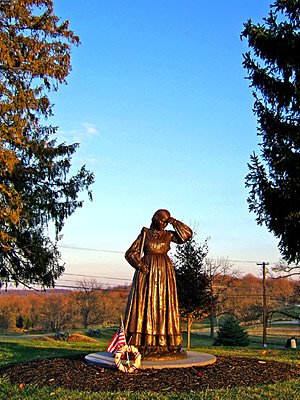 Monument to Elizabeth Thorn in Gettysburg's Evergreen Cemetery,
holding a shovel in her right arm.
Elizabeth would work very hard to put her home back together and to bury a number of the dead. She would later state, "Well, you may know how I felt, my husband in the army, my father an aged man. Yet for all the foul air, we started in. I struck off the graves and while my father finished one, I had another one started." The soon exhausted Elizabeth sought help among her friends. None endured for long however, all leaving for their homes within days due to illness. Elizabeth and her elderly father found themselves alone facing this exhausting work. She said of her predicament, "By that time we had forty graves done. And then father and I had to dig on harder again."
Elizabeth's efforts proved truly remarkable given that, during this time, she was six to seven months pregnant. A short time later, Elizabeth Thorn gave birth to precious little "Rose Meade Thorn", named in part for the commanding general of the victorious Union Army.
Sincerely,
Randy
Please visit my primary site at www.brotherswar.com
All original material Copyright © 2006. All Rights Reserved
Source: Beyond the Gatehouse. Gettysburg's Evergreen Cemetery. Brian A. Kennell, Evergreen Cemetery Association, 2000
One of the unique heroines of the Civil War, Elizabeth Thorn lived in Gettysburg and experienced the horrors of war first hand. Her husband Peter had enlisted one year prior to the battle leaving her as the Evergreen Cemetery's sole caretaker, a position the two had shared until the 1862. Before the Battle of Gettysburg, Elizabeth had averaged about 5 burials a month. Her charge would increase dramatically when the Armies of General Robert E. Lee and General George Gordon Meade collided in the fields around her home. The human wreckage was indescribable. About 10,000 dead lay upon the newly christened battlefield.
 Monument to Elizabeth Thorn in Gettysburg's Evergreen Cemetery,
holding a shovel in her right arm.
Elizabeth would work very hard to put her home back together and to bury a number of the dead. She would later state, "Well, you may know how I felt, my husband in the army, my father an aged man. Yet for all the foul air, we started in. I struck off the graves and while my father finished one, I had another one started." The soon exhausted Elizabeth sought help among her friends. None endured for long however, all leaving for their homes within days due to illness. Elizabeth and her elderly father found themselves alone facing this exhausting work. She said of her predicament, "By that time we had forty graves done. And then father and I had to dig on harder again."
Elizabeth's efforts proved truly remarkable given that, during this time, she was six to seven months pregnant. A short time later, Elizabeth Thorn gave birth to precious little "Rose Meade Thorn", named in part for the commanding general of the victorious Union Army.
Sincerely,
Randy
Please visit my primary site at www.brotherswar.com
All original material Copyright © 2006. All Rights Reserved
Source: Beyond the Gatehouse. Gettysburg's Evergreen Cemetery. Brian A. Kennell, Evergreen Cemetery Association, 2000
Monday, October 23, 2006
Short Story: A Personal Casualty
Leaning his head back, he sat against the base of a thickly gnarled elm away from the others in camp. The heavy roots jutting up from the cool soil seemed welcoming, as if forming a place of respite just for him. Staring blankly at nothing, he wished he could to draw strength from the stoic old tree, perhaps gaining its secrets on weathering life’s storms. Letting his head roll to the side, he somewhat involuntarily focused on the thick lines of bark, tracing them with his eyes, following the deeps grooves carved in its rough timeworn trunk. Seeing an old wound long since healed, he wondered if he would prove as resilient as this longtime tenant of the deep Virginia wilderness.
Although quite removed from the others, he remained safely within the protective line of their pickets. He was alone yet, to him, not alone enough. Tonight, he found his tent suffocating, the sides seeming to collapse in around him. The normally welcome comradery of the others now simply scratched at his pain. Images only a few hours old played in his mind, dangled in front of him by some malicious, unseen puppeteer. His struggle to slow, if not to altogether bury his thoughts, had thus far proved fruitless. Though he told himself that he knew of the inevitability of this moment, he had not anticipated the unbearable anxiety that now gripped him.
The government’s impassioned calls for men had eventually drawn him in. It seemed to him that the whole town had signed up. If not everyone, then at least most of those with whom he had spent his childhood had committed to fight. Sure, he shared their sense of the Union’s importance. He shared their patriotism. After all, he loved the land of his family’s birth. However, unlike the others who dreamed of adventure and glory, he dreaded what enlisting would eventually mean, what fighting would require of him. He had naively thought that he could anticipate and thus prepare for the trials of battle and that he could cope. He always considered himself an insightful thinker. But he could not have predicted the unexpected intensity of this painfully intolerable burden.
Although only a few hours had passed, it seemed lifetimes ago that his regiment settled in for the approaching spring night, cooking over a sprinkling of fires while talking of the likely events to come. Having spent the entirety of his short army career guarding the Capitol, he had wondered how he might face his first test in the field.
He had pictured orderly lines of battle, led by their Colonel as commanded by their Generals. The army would march, move, stand, and fight as a disciplined unit, advance as needed, and withdraw when compelled. They would follow their officer’s leads and force an end to this secessionist madness. Life could then continue as it had.
This idyllic fantasy surrendered to a grim reality when the men camped to their right came crashing through their ranks in a perfect unexplained panic. Something had gone terribly wrong. Understanding immediately what this portended, their experienced Colonel, in his thick German accent, ordered the men to form ranks, shift to the right, load, and fire. Despite his foreign tongue, his bearing commanded respect. They instantly understood and quickly obeyed. The enemy was almost upon them. This proved however, their last attempt at organized movement that day. Their gallant Colonel, leading his men from in front, fell to the ground the first casualty of the sudden conflict. Others began to fall as minie balls swarmed like hornets in the breezy evening air. After some fretful uncertainty, the men broke in harried unmilitary disarray. A few fired first. Most simply ran.
Although he had initially looked to his right and left to see who might stand with him, he too ran. Dense shrubs and forest debris proved no obstacle in his quest for safer ground. Running with his still loaded musket, a voice inside called him to remember his duty and fight honorably. Crashing through the brush running to save his life, he could hear the Rebels close behind him letting loose their spine chilling demonic screams. Jumping into a slight depression, he turned to gage his distance from his gray clad pursuers. A particularly energetic Johnny raced towards him, some yards in front of even their color bearer. Perhaps now had not been a good time to stop. As the Johnny began to point his musket towards him, instinctively, and for the first time, he lowered his own rifle, aimed at the man in gray, and fired.
As if appalled by this sudden violation, time seemed to suspend its energies on this now execrably christened field. All motion seemed to slow. His southern pursuer stopped suddenly, a look of shocked disbelief and resigned comprehension painfully etched in his young face. His expression bespoke no anger, no resentment, no accusation, just stunned disbelief quickly displaced by a longing, silent plea for help. The eyes of this man, startlingly more human than any into which he had looked before, fell as the gray clad soldier’s body hit the unforgiving ground. The growing stain on his loose cotton shirt spoke of this man’s inevitable fate. Staring transfixed at the man in mystified horror, some sense of self-preservation shocked him back into awareness, reminding him of the present approaching danger. With the now enraged Rebels closing quickly, he threw his musket aside and, lightened of its burden, once again fled.
Time rejoined the drama, seeming to push him on his way as if to make up for its delinquencies of the past few seconds. Filled with the energy of near frightened hysteria, he easily outpaced his yelling pursuers. Branches, twigs, and undergrowth crunched under the steady pounding of his quickly moving feet, blending with the crackling sounds of musketry and the booming thundering accompaniment of dueling artillery. After a time and with perhaps a mile of ground behind him, he joined the reformed blue lines and night mercifully closed on the carnage. Now, he sat near camp, tormented by the lingering images of this terrible day.
He had never killed a man, nor had he seen one die. He could only think of the Johnny as a man, not as a Reb, a traitor, or the enemy. Alone on the cold dead ground, his victim was only a man like him, minus the unique gift of the precious breath of life. His soul ached with the pain that his victim no longer felt. He thought that perhaps an angry God had taken from him the serenity that perhaps both men held earlier today. The admonishment “Thou Shalt Not Kill” broke repeatedly and forcefully into his tortured thoughts. “He would have surely killed me or at least tried,” he feebly argued in defense. He rubbed his rough dirty hands hard over his suddenly older face, trying to erase the pain. He could not bear this. “I did my duty!” his inner voice defiantly shouted in response to the agony that savaged his conscience. “I did what I had to do!”
Perhaps with time he might convince himself that he had violated no moral laws. Perhaps with time, the pain would subside. But for now, although far from that place, the imploring pleading eyes of that man remained with him, staring back at him. He could still see his eyes and, to his horror, could almost see through them. He envisioned the man’s family, perhaps the children who would never again run to him, and the wife he would never hold. He saw his parents, children, and friends, wracked with an intense, bitter grief over a loss they could do nothing to undo, a loss caused by his hand.
The evening winds gently swayed the treetops and, as if to provide a merciful distraction, the old elm dropped a few twigs to the ground nearby. Snatching one within reach, he mindlessly began peeling the bark in short strips. He thought of his father, a hard working farmer who had taught him the craft of slaughtering and butchering livestock. “This is hard for me Papa,” he recalled saying to his father, trying to hold back the tears after he had reluctantly killed his first lamb. The older man’s words rang clearly in his ears, pushing from the fore the eyes which threatened to consume him. “Son, when this becomes easy, you need to stop and look at who you’ve become.”
It was not cold, yet he tossed aside his twig and pulled his blanket tightly around him, wishing for the innocence of the safer childhood he mournfully recalled and for his father’s practical strength. He stared into the darkness, searching for the eyes that he could no longer see, fearing that he would see them again and also that he might not. “What had he become?” he wondered. “What would he do tomorrow?”
Although he laid down a mile away, he felt somehow that he shared the same ground as that where his personal casualty now rested. Though he yet lived, had emerged from the fight physically unscathed, he wondered how he would survive what he had done. “This is what this is all about,” he thought, to a degree chastising himself. “To engage in war you must kill, one person at a time. No matter how the illustrated papers say it, announcing the hundreds or thousands of dead, it happens with one man killing one other, one at a time.”
Wrapped in his blanket, he tossed about on the rough ground as if wrestling with some unseen foe. His mind raced through a haze of images from both this day and his past. The lessons of his parents, his schooling, and his church all danced furiously, colliding violently with today’s incongruous events. For a while, the directionless mental conflagration continued. Then suddenly, the storm passed. His mind cleared. He knew that he could kill no more. That night, he slipped quietly through the picket line, leaving the trappings of war behind, and walked into the darkness away from someone he could not become. As he traveled through the night-shrouded woodland, he gazed upward through the swaying trees towards the stars above and offered an earnest quiet prayer for the man whose life he had taken, asking for peace for them both and for us all.
Sincerely,
Randy
Please visit my primary site at www.brotherswar.com
All original material Copyright © 2006. All Rights Reserved
Although quite removed from the others, he remained safely within the protective line of their pickets. He was alone yet, to him, not alone enough. Tonight, he found his tent suffocating, the sides seeming to collapse in around him. The normally welcome comradery of the others now simply scratched at his pain. Images only a few hours old played in his mind, dangled in front of him by some malicious, unseen puppeteer. His struggle to slow, if not to altogether bury his thoughts, had thus far proved fruitless. Though he told himself that he knew of the inevitability of this moment, he had not anticipated the unbearable anxiety that now gripped him.
The government’s impassioned calls for men had eventually drawn him in. It seemed to him that the whole town had signed up. If not everyone, then at least most of those with whom he had spent his childhood had committed to fight. Sure, he shared their sense of the Union’s importance. He shared their patriotism. After all, he loved the land of his family’s birth. However, unlike the others who dreamed of adventure and glory, he dreaded what enlisting would eventually mean, what fighting would require of him. He had naively thought that he could anticipate and thus prepare for the trials of battle and that he could cope. He always considered himself an insightful thinker. But he could not have predicted the unexpected intensity of this painfully intolerable burden.
Although only a few hours had passed, it seemed lifetimes ago that his regiment settled in for the approaching spring night, cooking over a sprinkling of fires while talking of the likely events to come. Having spent the entirety of his short army career guarding the Capitol, he had wondered how he might face his first test in the field.
He had pictured orderly lines of battle, led by their Colonel as commanded by their Generals. The army would march, move, stand, and fight as a disciplined unit, advance as needed, and withdraw when compelled. They would follow their officer’s leads and force an end to this secessionist madness. Life could then continue as it had.
This idyllic fantasy surrendered to a grim reality when the men camped to their right came crashing through their ranks in a perfect unexplained panic. Something had gone terribly wrong. Understanding immediately what this portended, their experienced Colonel, in his thick German accent, ordered the men to form ranks, shift to the right, load, and fire. Despite his foreign tongue, his bearing commanded respect. They instantly understood and quickly obeyed. The enemy was almost upon them. This proved however, their last attempt at organized movement that day. Their gallant Colonel, leading his men from in front, fell to the ground the first casualty of the sudden conflict. Others began to fall as minie balls swarmed like hornets in the breezy evening air. After some fretful uncertainty, the men broke in harried unmilitary disarray. A few fired first. Most simply ran.
Although he had initially looked to his right and left to see who might stand with him, he too ran. Dense shrubs and forest debris proved no obstacle in his quest for safer ground. Running with his still loaded musket, a voice inside called him to remember his duty and fight honorably. Crashing through the brush running to save his life, he could hear the Rebels close behind him letting loose their spine chilling demonic screams. Jumping into a slight depression, he turned to gage his distance from his gray clad pursuers. A particularly energetic Johnny raced towards him, some yards in front of even their color bearer. Perhaps now had not been a good time to stop. As the Johnny began to point his musket towards him, instinctively, and for the first time, he lowered his own rifle, aimed at the man in gray, and fired.
As if appalled by this sudden violation, time seemed to suspend its energies on this now execrably christened field. All motion seemed to slow. His southern pursuer stopped suddenly, a look of shocked disbelief and resigned comprehension painfully etched in his young face. His expression bespoke no anger, no resentment, no accusation, just stunned disbelief quickly displaced by a longing, silent plea for help. The eyes of this man, startlingly more human than any into which he had looked before, fell as the gray clad soldier’s body hit the unforgiving ground. The growing stain on his loose cotton shirt spoke of this man’s inevitable fate. Staring transfixed at the man in mystified horror, some sense of self-preservation shocked him back into awareness, reminding him of the present approaching danger. With the now enraged Rebels closing quickly, he threw his musket aside and, lightened of its burden, once again fled.
Time rejoined the drama, seeming to push him on his way as if to make up for its delinquencies of the past few seconds. Filled with the energy of near frightened hysteria, he easily outpaced his yelling pursuers. Branches, twigs, and undergrowth crunched under the steady pounding of his quickly moving feet, blending with the crackling sounds of musketry and the booming thundering accompaniment of dueling artillery. After a time and with perhaps a mile of ground behind him, he joined the reformed blue lines and night mercifully closed on the carnage. Now, he sat near camp, tormented by the lingering images of this terrible day.
He had never killed a man, nor had he seen one die. He could only think of the Johnny as a man, not as a Reb, a traitor, or the enemy. Alone on the cold dead ground, his victim was only a man like him, minus the unique gift of the precious breath of life. His soul ached with the pain that his victim no longer felt. He thought that perhaps an angry God had taken from him the serenity that perhaps both men held earlier today. The admonishment “Thou Shalt Not Kill” broke repeatedly and forcefully into his tortured thoughts. “He would have surely killed me or at least tried,” he feebly argued in defense. He rubbed his rough dirty hands hard over his suddenly older face, trying to erase the pain. He could not bear this. “I did my duty!” his inner voice defiantly shouted in response to the agony that savaged his conscience. “I did what I had to do!”
Perhaps with time he might convince himself that he had violated no moral laws. Perhaps with time, the pain would subside. But for now, although far from that place, the imploring pleading eyes of that man remained with him, staring back at him. He could still see his eyes and, to his horror, could almost see through them. He envisioned the man’s family, perhaps the children who would never again run to him, and the wife he would never hold. He saw his parents, children, and friends, wracked with an intense, bitter grief over a loss they could do nothing to undo, a loss caused by his hand.
The evening winds gently swayed the treetops and, as if to provide a merciful distraction, the old elm dropped a few twigs to the ground nearby. Snatching one within reach, he mindlessly began peeling the bark in short strips. He thought of his father, a hard working farmer who had taught him the craft of slaughtering and butchering livestock. “This is hard for me Papa,” he recalled saying to his father, trying to hold back the tears after he had reluctantly killed his first lamb. The older man’s words rang clearly in his ears, pushing from the fore the eyes which threatened to consume him. “Son, when this becomes easy, you need to stop and look at who you’ve become.”
It was not cold, yet he tossed aside his twig and pulled his blanket tightly around him, wishing for the innocence of the safer childhood he mournfully recalled and for his father’s practical strength. He stared into the darkness, searching for the eyes that he could no longer see, fearing that he would see them again and also that he might not. “What had he become?” he wondered. “What would he do tomorrow?”
Although he laid down a mile away, he felt somehow that he shared the same ground as that where his personal casualty now rested. Though he yet lived, had emerged from the fight physically unscathed, he wondered how he would survive what he had done. “This is what this is all about,” he thought, to a degree chastising himself. “To engage in war you must kill, one person at a time. No matter how the illustrated papers say it, announcing the hundreds or thousands of dead, it happens with one man killing one other, one at a time.”
Wrapped in his blanket, he tossed about on the rough ground as if wrestling with some unseen foe. His mind raced through a haze of images from both this day and his past. The lessons of his parents, his schooling, and his church all danced furiously, colliding violently with today’s incongruous events. For a while, the directionless mental conflagration continued. Then suddenly, the storm passed. His mind cleared. He knew that he could kill no more. That night, he slipped quietly through the picket line, leaving the trappings of war behind, and walked into the darkness away from someone he could not become. As he traveled through the night-shrouded woodland, he gazed upward through the swaying trees towards the stars above and offered an earnest quiet prayer for the man whose life he had taken, asking for peace for them both and for us all.
Sincerely,
Randy
Please visit my primary site at www.brotherswar.com
All original material Copyright © 2006. All Rights Reserved
Subscribe to:
Posts (Atom)
